
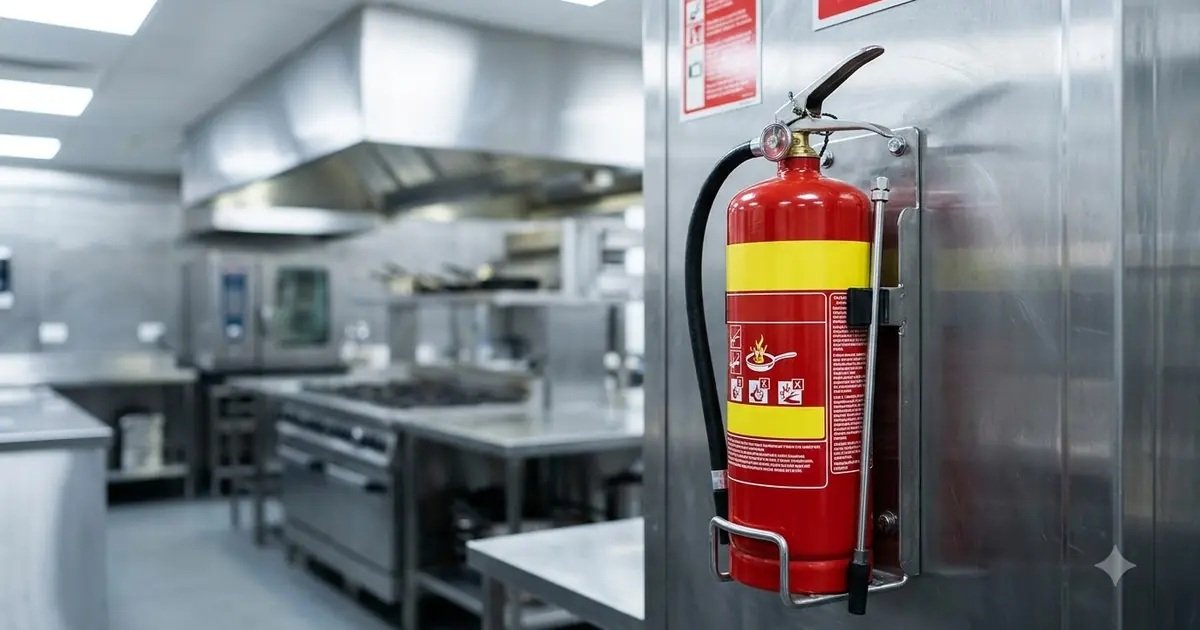
Quick Answer — What Is a K Type (Class K) Fire Extinguisher?
A Class K fire extinguisher is a wet chemical fire extinguisher made for fires in cooking oils and fats, such as deep fat fryers in restaurants and commercial kitchens. The alkaline agent reacts with hot oil to form a soapy foam blanket that seals and cools it. Class K is the US term; the UK and Europe call the same hazard Class F. Never use water on a grease fire. Commercial kitchens typically need a Class K extinguisher within about 30 ft (9 m) of fryers, but check local rules.
1. What Is a Class K (K Type) Extinguisher?
A K type fire extinguisher is rated for Class K fires: combustible cooking media such as vegetable oil, animal fat and other cooking oils. Because modern fryers use high-temperature, deep oils, ordinary extinguishers can fail to stop the fire or let it flash back.
Figure 1: Class K (US) and Class F (UK and Europe) describe the same cooking oil hazard.
For other extinguisher types, see our guide to types of fire extinguishers.
2. How a Wet Chemical Extinguisher Works
The extinguisher contains a water-based solution of alkaline potassium salts (commonly potassium acetate, carbonate or citrate). It is sprayed as a fine mist, which is gentle enough not to splash burning oil.
Figure 2: Saponification forms a soapy foam that seals the oil surface while the spray cools it.
- Cools the oil with the water content.
- Seals the surface with a soapy foam layer (saponification).
- Smothers by cutting off oxygen to the fuel.
- Reduces re-ignition, a major risk with hot oil.
3. Why Kitchen Fires Are Different
Cooking oil can ignite when it overheats and stays hot long after the flames are out. That is why grease fires can re-ignite if only the flames are knocked down.
Figure 3: Choose by fire type. Water and powder can make a deep fat fire worse.
| Extinguisher | On a grease fire | Why |
|---|---|---|
| Water | Dangerous | Sinks, flashes to steam and spreads burning oil |
| Standard dry powder (ABC) | Poor | Knocks flames but does not cool; oil can re-ignite |
| CO2 | Limited | Little cooling; not suited to deep fat fryers |
| Wet chemical (Class K / F) | Best | Cools and seals the oil surface |
| Fire blanket | Good for small pans | Smothers a small pan fire |
4. Who Needs a Class K Extinguisher?
- Restaurants, cafes and takeaways with fryers or woks.
- Canteens, hotels, schools and hospitals with commercial cooking.
- Food trucks and carts using fryers or griddles.
- Homes generally do not need Class K, but a fire blanket and lid help.
Local rules apply
In the US, NFPA 10 (portable extinguishers) and NFPA 96 (hood systems) are widely used, but your local fire code and insurer decide what is required. In the UK and EU, rely on Class F and your fire risk assessment.
5. Placement and Fixed Hood Systems
Figure 4: Place the extinguisher on the exit path within the allowed travel distance of the fryers.
- Mount it where you can reach it without crossing the fire.
- Keep it within 30 ft (9 m) of the hazard, as typically required under NFPA 10.
- A fixed hood suppression system usually protects the cooking line; the portable extinguisher is the backup.
- Make sure staff know the manual pull station and where to shut off gas.
6. How to Use It (PASS)
Figure 5: Alert, shut off, discharge gently, and leave if it is not under control.
- P - Pull the pin.
- A - Aim at the base of the flames from a safe distance.
- S - Squeeze the handle.
- S - Sweep gently across the surface; avoid splashing the oil.
Watch for re-ignition
After the flames are out, the oil may still be hot. Do not move the fryer, keep watching and call the fire service anyway.
7. Interactive Checkers
Do I need a Class K extinguisher?
Travel distance check
Grease fire response checklist
8. Choosing the Right Tool
| Situation | Best response |
|---|---|
| Small pan fire at home | Turn off heat, slide on a lid, or use a fire blanket |
| Fryer fire in a commercial kitchen | Fixed system, then Class K wet chemical if needed |
| Fire spreading beyond the appliance | Evacuate and call the fire service |
| Live electrical fire | CO2 or dry powder, never water or wet chemical on live equipment |
9. Inspection and Maintenance
- Do regular visual checks: gauge in the green, pin and seal intact, no damage.
- Have it serviced by a qualified professional on your local code schedule.
- Replace or recharge after any discharge, even a short one.
- Keep the access clear and train staff regularly.
Quick Summary
| Topic | Key point |
|---|---|
| Class K / Class F | Cooking oil and fat fires (US / UK and Europe) |
| Agent | Alkaline wet chemical that forms soapy foam |
| Never use | Water, or a standard powder on deep fat fires |
| Commercial kitchens | Class K near fryers, typically within 30 ft, plus hood system |
| Home | Lid, fire blanket and a kitchen-suitable extinguisher |
Safety and Compliance Notice
This guide is general information, not a code interpretation. Requirements, labels and colours vary by country and local authority. Consult your fire marshal, insurer or a licensed fire protection company. If a fire is not small and controlled, evacuate and call the fire service.
Frequently Asked Questions (FAQ)
A Class K extinguisher is a wet chemical fire extinguisher designed for fires involving cooking oils and fats, such as vegetable oil or animal fat in commercial deep fryers. The term Class K is used in the United States.
A K type fire extinguisher is used on fires in cooking oil and fat, mainly in restaurants, catering kitchens, canteens and food trucks. It sprays a fine mist of an alkaline wet chemical that forms a soapy foam over the burning oil.
It is an extinguisher filled with a water-based solution of potassium salts such as potassium acetate, carbonate or citrate. It is applied as a fine spray that cools the fire and reacts with hot oil to create a seal.
They describe the same kind of hazard, cooking oil and fat fires. Class K is the North American term, while Class F is used in the UK, Europe and many other regions. Both are fought with a wet chemical extinguisher.
The alkaline agent reacts with the hot fat in a process called saponification, forming a soapy foam layer. The foam seals the surface and cuts off oxygen while the water content cools the oil, which reduces the risk of re-ignition.
No. Water sinks below burning oil, turns to steam and can throw flaming oil outward, spreading the fire. Use a Class K or F extinguisher, a fire blanket on a small pan, or cover the pan with a lid if it is safe to do so.
Generally no. Class K extinguishers are intended for commercial cooking equipment. At home, fire safety groups commonly advise keeping the pan lid or a fire blanket handy and a general-purpose extinguisher suitable for kitchens. Some wet chemical extinguishers are made for home use, so follow the label and local guidance.
In the US, NFPA 10 calls for Class K extinguishers where there are appliances using combustible cooking media such as vegetable or animal oils and fats, and local codes decide the details. Commercial kitchens usually also need a fixed hood suppression system. Confirm requirements with your local fire authority.
NFPA 10 sets a maximum travel distance of 30 feet (about 9 metres) from the hazard to a Class K extinguisher. It should be easy to reach without walking through the fire, and local rules may differ, so check with your authority having jurisdiction.
Many wet chemical extinguishers are also rated for ordinary combustibles such as wood, paper and cloth, but not for live electrical equipment or flammable liquids like petrol. Always read the label and the classification on the cylinder.
Use the PASS method: pull the pin, aim at the base of the fire from a safe distance, squeeze the handle and sweep gently. Apply the agent softly so it lands on the oil without splashing, then keep watching for re-ignition. Evacuate if the fire grows.
Check it visually regularly, make sure the gauge is in the green and the seal and pin are intact, and have it serviced by a qualified professional on the schedule your local code requires. Replace or recharge it after any use.